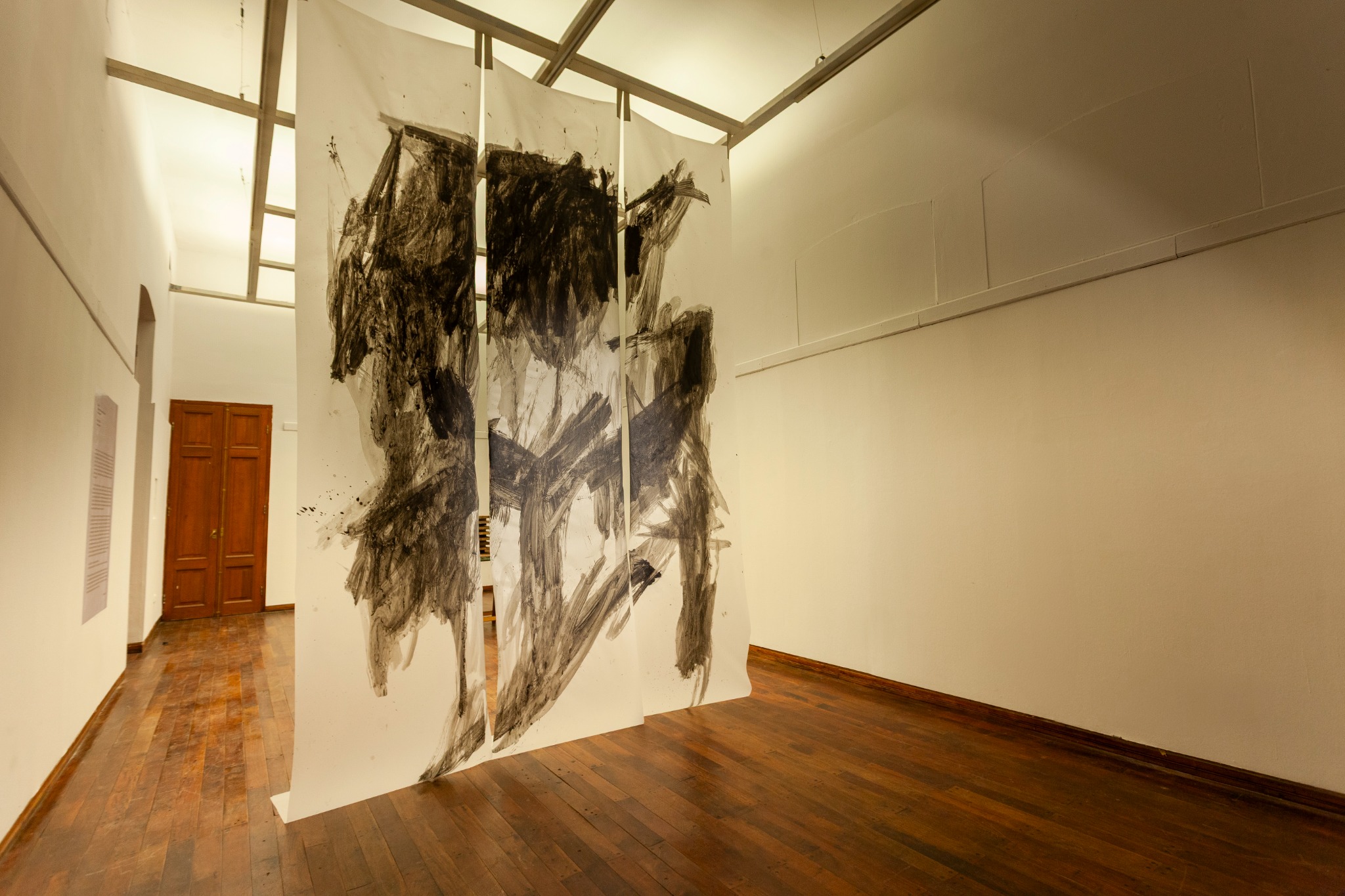
Fog.
Acrylic and ink on tracing paper.400 × 300 cm.
Fog is a painting from I Die, but Tomorrow I Will Reincarnate at 6, Don’t Be Afraid, an exhibition project made with Rodro Cañás.Museum of the National University of Tucumán.Photography: Agustín Indri.
Some accounts say that up there in the mountains, exactly where the trees now stand, there was once a clearing. Haloes on a non-human scale, like those left by Martian landings. Some say the trees grew first and construction of the city began the following year. Other theories claim the reverse. According to the latter, the city was devised to conceal extraterrestrial traces. The fact that this city project and its buildings currently constitute a nonexistent reality fuels the debate. What came first. What came after.
The case of the unfinished city—which is not, or is at once, a ruin, a vestige and an imposing concrete block—also complicates perception. For some people, the abandoned building is no more than a memory of something experienced by humanity in earlier decades. In certain bodies, however, that abandoned building project between the mountain and the trees becomes embedded in the mind; it is memory, stories of other planets and possible times, transmitted from one generation to the next.
Perhaps it is because of these distractions that the matter of magnetic forces generally goes unnoticed. Yet it is known: since that landing in the mountains, and even since the very beginning of its construction, the city has commanded everything that happens in this territory. It is a provincial government; the ruins exercise it through a persuasion that is not entirely evident. Its source of power is electromagnetic, and from above the city directs destinies. Sometimes these are repulsive forces, and then things, days, seem to break apart. In other cases, electromagnetic force reunites everything that has separated. From that union emerge lines of dark paint that sweat the texture of original surfaces onto tracing paper, secret poems, reverberations of buildings that might be suspended over blocks of concrete, wood or water, or words, books.
—Is that all? some voices ask. —There are reincarnations too, the ruins reply, as fog spreads over them.
Those whom repulsive forces have separated wait for electromagnetism to find them. Those who carry the ruins within their minds wonder whether the city itself will live again. They say it will, though no one can determine when. The theories promise only that it will reincarnate one day. At six o’clock.
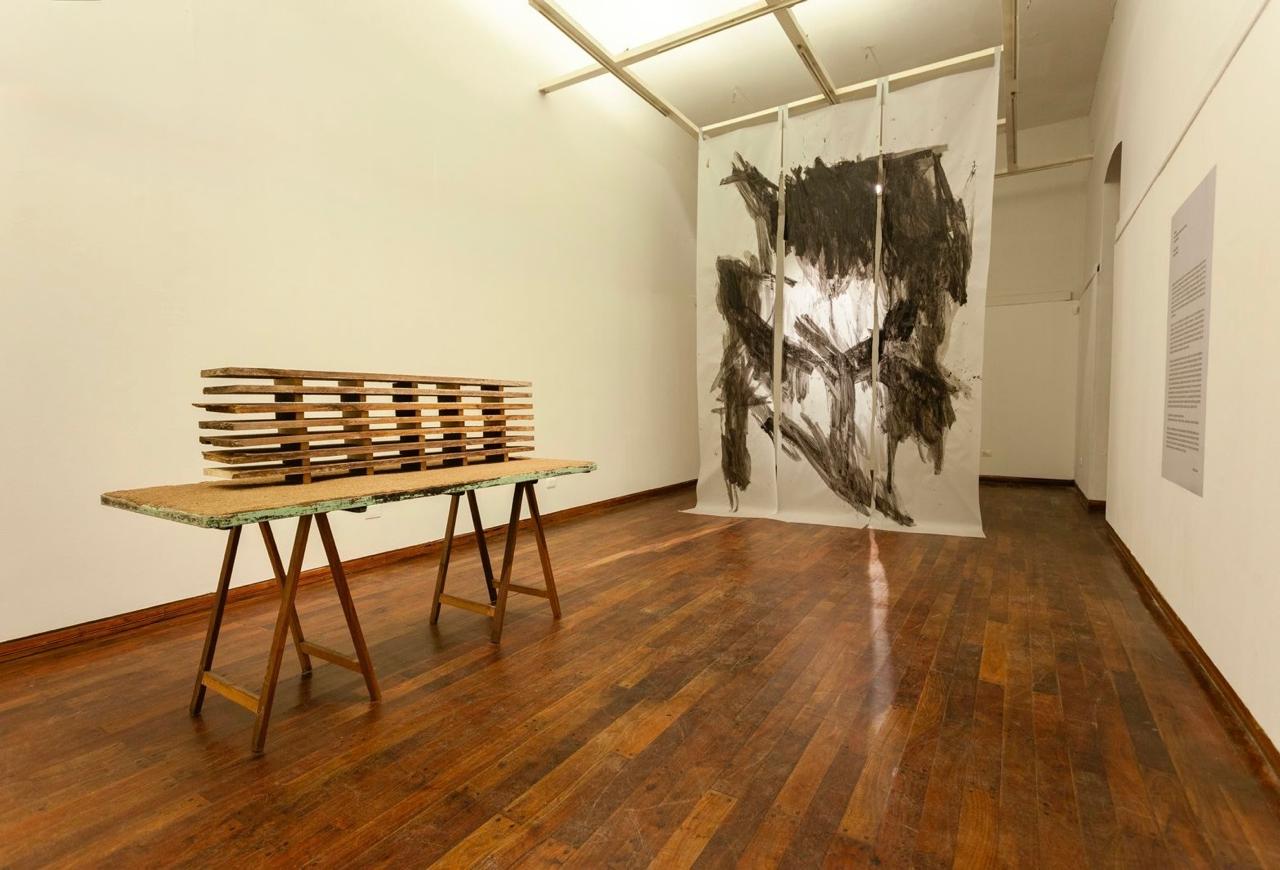
Fog.
Acrylic and ink on tracing paper.400 × 300 cm.
Fog is a painting from I Die, but Tomorrow I Will Reincarnate at 6, Don’t Be Afraid, an exhibition project made with Rodro Cañás.Museum of the National University of Tucumán.Photography: Agustín Indri.
Some accounts say that up there in the mountains, exactly where the trees now stand, there was once a clearing. Haloes on a non-human scale, like those left by Martian landings. Some say the trees grew first and construction of the city began the following year. Other theories claim the reverse. According to the latter, the city was devised to conceal extraterrestrial traces. The fact that this city project and its buildings currently constitute a nonexistent reality fuels the debate. What came first. What came after.
The case of the unfinished city—which is not, or is at once, a ruin, a vestige and an imposing concrete block—also complicates perception. For some people, the abandoned building is no more than a memory of something experienced by humanity in earlier decades. In certain bodies, however, that abandoned building project between the mountain and the trees becomes embedded in the mind; it is memory, stories of other planets and possible times, transmitted from one generation to the next.
Perhaps it is because of these distractions that the matter of magnetic forces generally goes unnoticed. Yet it is known: since that landing in the mountains, and even since the very beginning of its construction, the city has commanded everything that happens in this territory. It is a provincial government; the ruins exercise it through a persuasion that is not entirely evident. Its source of power is electromagnetic, and from above the city directs destinies. Sometimes these are repulsive forces, and then things, days, seem to break apart. In other cases, electromagnetic force reunites everything that has separated. From that union emerge lines of dark paint that sweat the texture of original surfaces onto tracing paper, secret poems, reverberations of buildings that might be suspended over blocks of concrete, wood or water, or words, books.
—Is that all? some voices ask. —There are reincarnations too, the ruins reply, as fog spreads over them.
Those whom repulsive forces have separated wait for electromagnetism to find them. Those who carry the ruins within their minds wonder whether the city itself will live again. They say it will, though no one can determine when. The theories promise only that it will reincarnate one day. At six o’clock.