Small Limit.
Solo exhibition.Museo Municipal de Arte Moderno de Mendoza (MMAMM).
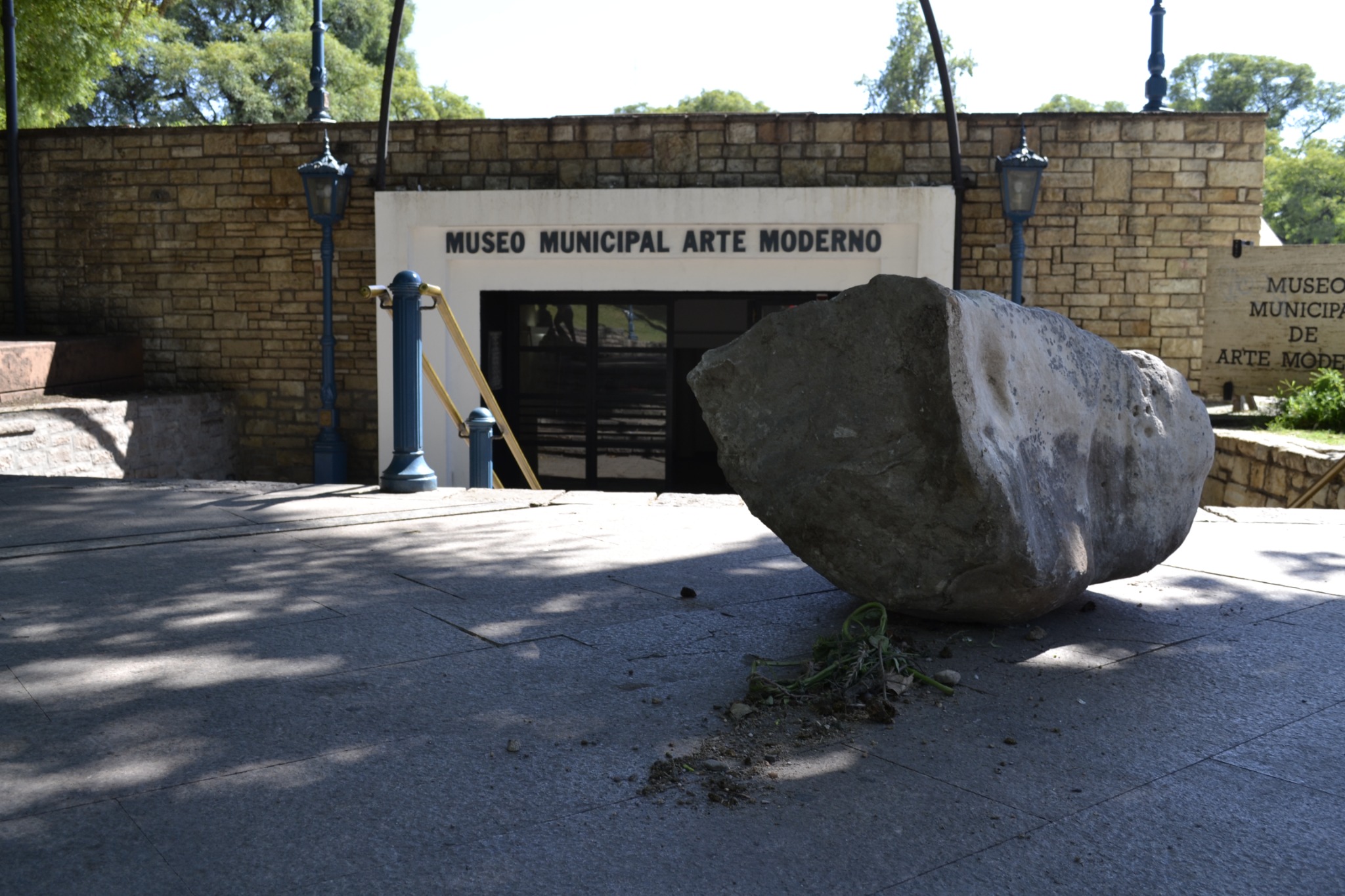
Bruno Juliano places a silvered stone at the museum entrance. While the work is displayed outside, inside we find an emptied gallery whose floor is entirely covered with black plastic. A hole opens in one wall and, in a distant corner, a tent-like roof receives water falling from the leaks.
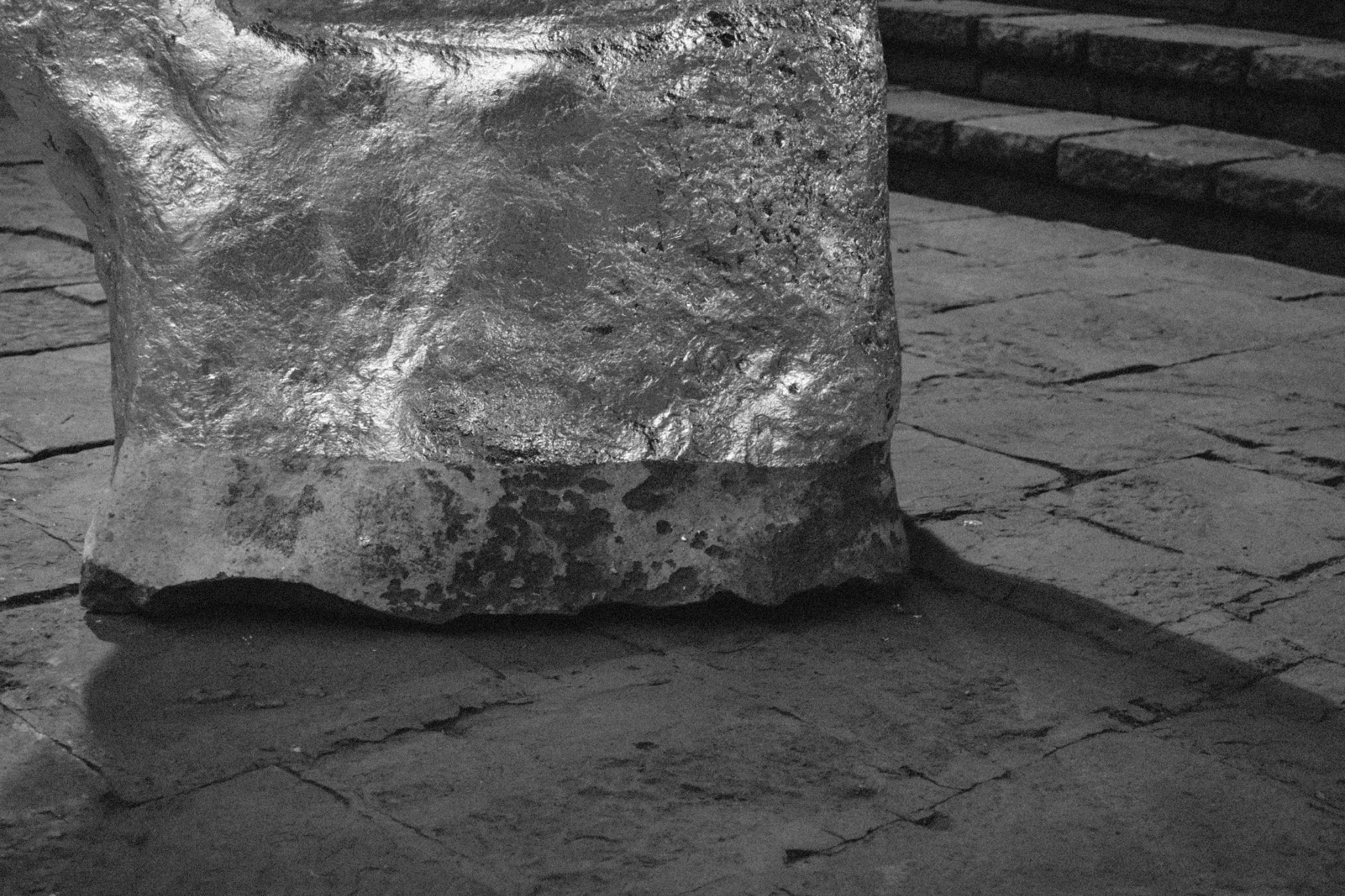
The stone is covered with silver leaf above a line twenty centimetres from its base—the maximum level reached by water during one of the museum’s floods. In sunlight, this amorphous sphinx becomes a mirror of the sky, producing a moment of poetic stridency outdoors.
The line separating the silvered and unpainted sections continues inside the gallery, where the plastic rises along the walls to the same height. It joins the exterior’s romantic, monumental object to the naked and precarious interior, producing a powerful collision between two realities.
Inside, lights illuminate the ceiling and its leaks; drops draw circles of different sizes on the plastic floor. Yet the pictorial character of this trashed landscape gives way to operations that expose the museum’s conditions and workings.
Juliano opens a hole in a wall to reveal the collection storage area, placing visitors in an uncomfortable position from which to discover the works. He also removes part of the institutional archive and exhibits it in the gallery, making ordinarily inaccessible information available to the public.
Juliano perceptively turns his attention to architectural context and institutional operation. In Small Limit, the space becomes an object of experimentation: the building’s structural precariousness is transformed into an artistic resource. This procedure is not new to Juliano, who previously rescued and re-signified the crypt of a traditional Salesian school in Tucumán, transforming it into a centre for the exhibition and circulation of contemporary art.
The crypt depends on a pump motor; when it stops, underground rivers suddenly fill the space with water. It therefore functions as an architectural laboratory in which works and exhibitions adapt to and intensify its spatial conditions.
Over the years, Juliano has developed a distinctive aesthetics of montage and become an intelligent and sensitive reference for conceptual operations involving spatial and semantic displacement. Small Limit demonstrates his capacity to approach projects through spatial politics that are at once critical and poetic.
Small Limit.
Solo exhibition.Museo Municipal de Arte Moderno de Mendoza (MMAMM).
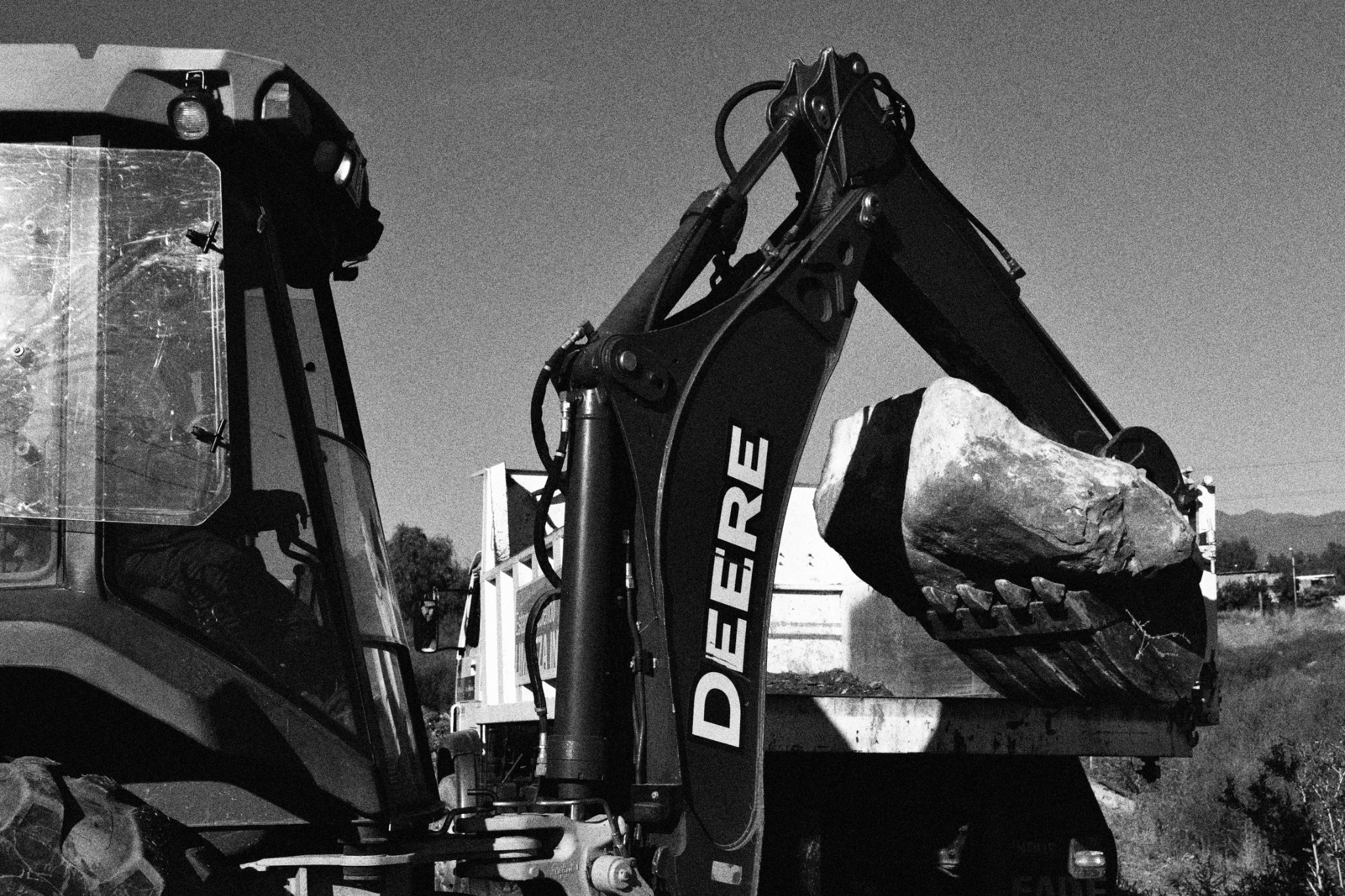
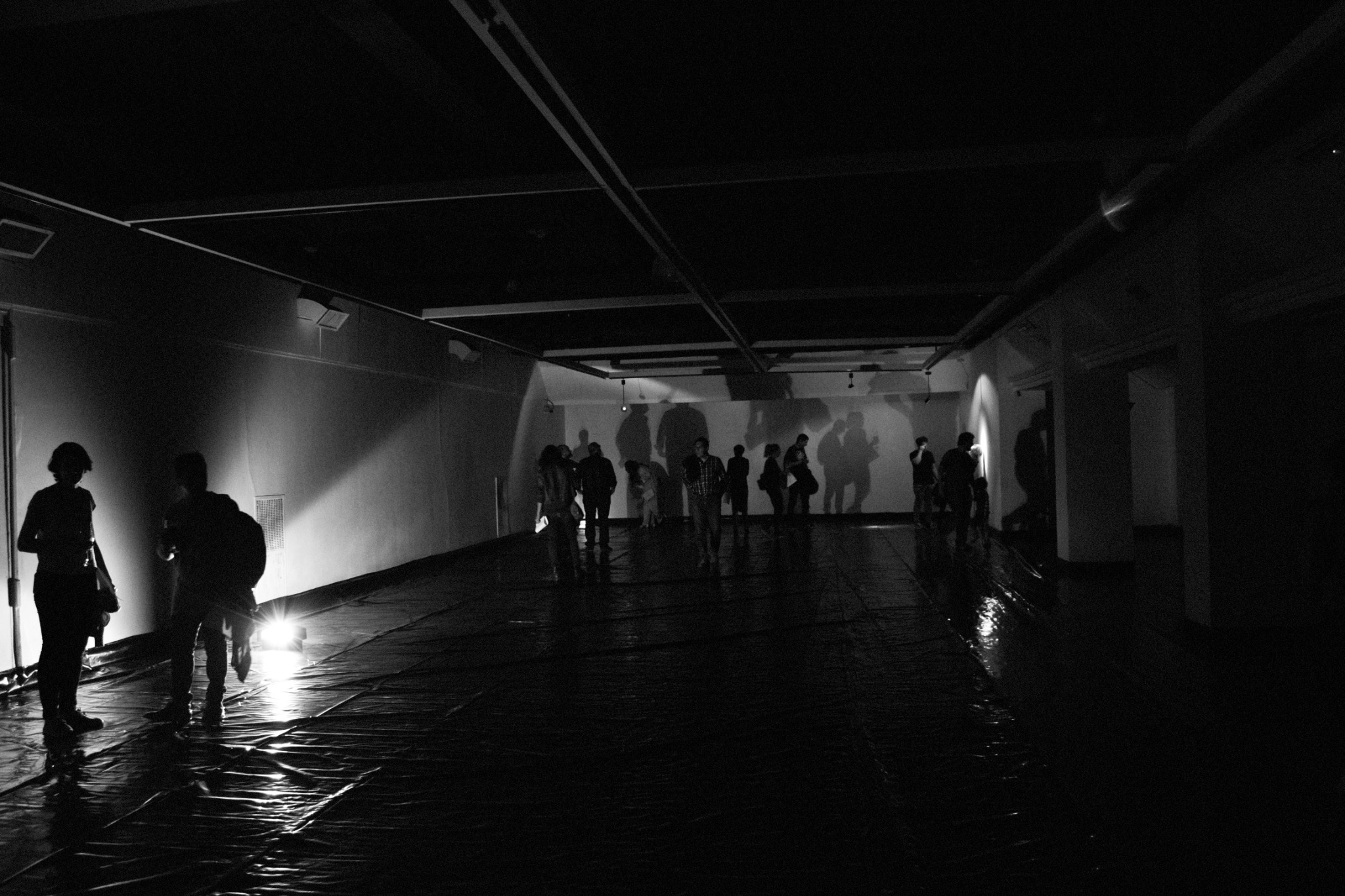
Bruno Juliano places a silvered stone at the museum entrance. While the work is displayed outside, inside we find an emptied gallery whose floor is entirely covered with black plastic. A hole opens in one wall and, in a distant corner, a tent-like roof receives water falling from the leaks.
The stone is covered with silver leaf above a line twenty centimetres from its base—the maximum level reached by water during one of the museum’s floods. In sunlight, this amorphous sphinx becomes a mirror of the sky, producing a moment of poetic stridency outdoors.
The line separating the silvered and unpainted sections continues inside the gallery, where the plastic rises along the walls to the same height. It joins the exterior’s romantic, monumental object to the naked and precarious interior, producing a powerful collision between two realities.
Inside, lights illuminate the ceiling and its leaks; drops draw circles of different sizes on the plastic floor. Yet the pictorial character of this trashed landscape gives way to operations that expose the museum’s conditions and workings.
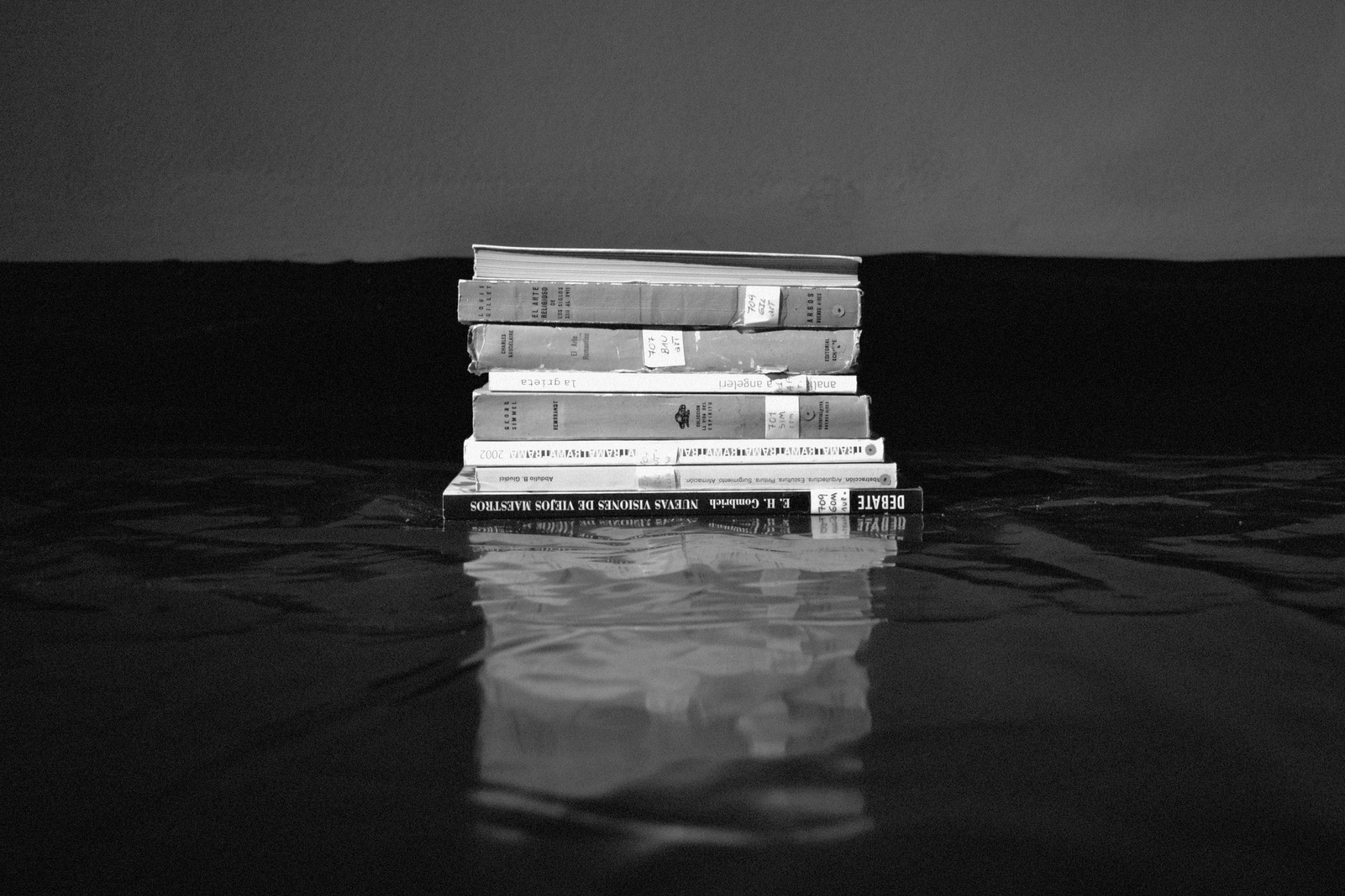
Juliano opens a hole in a wall to reveal the collection storage area, placing visitors in an uncomfortable position from which to discover the works. He also removes part of the institutional archive and exhibits it in the gallery, making ordinarily inaccessible information available to the public.
Juliano perceptively turns his attention to architectural context and institutional operation. In Small Limit, the space becomes an object of experimentation: the building’s structural precariousness is transformed into an artistic resource. This procedure is not new to Juliano, who previously rescued and re-signified the crypt of a traditional Salesian school in Tucumán, transforming it into a centre for the exhibition and circulation of contemporary art.
The crypt depends on a pump motor; when it stops, underground rivers suddenly fill the space with water. It therefore functions as an architectural laboratory in which works and exhibitions adapt to and intensify its spatial conditions.
Over the years, Juliano has developed a distinctive aesthetics of montage and become an intelligent and sensitive reference for conceptual operations involving spatial and semantic displacement. Small Limit demonstrates his capacity to approach projects through spatial politics that are at once critical and poetic.